
What does an accountant do? What are bookkeeper duties? These topics remain hot because there’s often a lot of confusion about it. As a small business owner, you have to do your best to allocate your resources wisely.
Sometimes grasping the difference between bookkeeping and accounting can be tricky. Both bookkeepers and accountants work with your finances, both help make your tax reporting a smooth experience. Still, there are some differences that every business owner needs to know when deciding which to choose for their company.
In this article, I’ll cover these and some other key questions that may help you choose the better fit for your business.
Contents:
1. Bookkeeping vs. accounting: what is the difference between bookkeeping and accounting?
2. What is the role of the bookkeeper?
3. What is the role of an accountant?
4. Bookkeeper vs. accountant: how to decide what financial specialist is best for your business?
5. Bookkeeping vs. accounting key takeaways
Bookkeeping vs. accounting: what is the difference between bookkeeping and accounting?
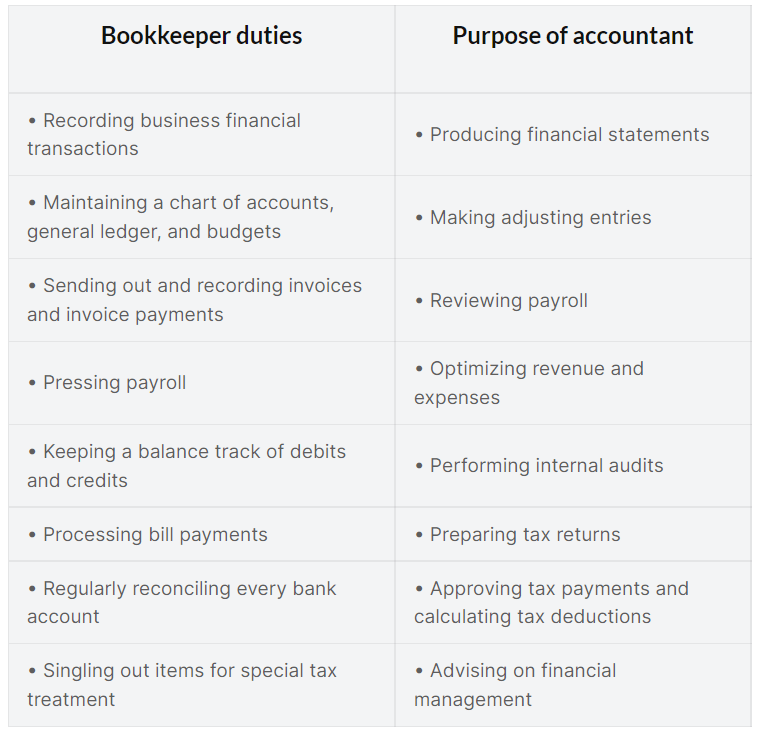
The bookkeeper’s responsibilities are typically connected with financial transactions and general business administration, while the primary functions of accounting are processing the financial information produced by the bookkeeper and, based on it, generating business insights and providing financial forecasts.
In practice, the distinction can get quite hazy. With many accounting automation solutions available on the market, bookkeepers have been freed from the manual tasks of data entry. Nowadays bookkeepers can use the opportunity to give more insight and sometimes play the role of an advisor.
This way, bookkeeping and accounting can sometimes overlap. But certain points of difference remain: the bookkeeper will likely manage your ongoing financial records, ensuring the accuracy of the data in your books. And what does an accountant do? An accountant will analyze this data, do reporting, give you financial advice, and offer you tax processing services.
Now, let’s take a close look at each of the options: Bookkeeper vs Accountant.
What is the role of the bookkeeper?
Bookkeepers provide an essential insight into the financials of the company. They make sure that all financial operations are run smoothly and recorded regularly, and ensure that tax season isn’t stressful. They prepare all reports necessary to file taxes in a timely manner.
The bookkeeper can be found working in small, medium, or large business organizations. Bookkeeper responsibilities are keeping track of the company’s financial records and documenting them in appropriate journals or ledgers.
What is the role of an accountant?
Typically, professionals in bookkeeping and accounting spheres work together. Often the bookkeeper will serve as an expert at using the latest software to track transactions and generate financial reports, while the ultimate purpose of the accountant will be to have a larger perspective in overseeing your business.
They might perform tasks such as budgeting, analyzing, planning, but are unlikely to deal with everyday processes of recording transactions. Accountants are also responsible for providing tax and representation on taxation matters.
Bookkeeper vs. accountant: how to decide what financial specialist is best for your business?
Young businesses often get away with doing their accounting and bookkeeping responsibilities themselves. In the long-run, it wouldn’t be financially wise to keep doing that, as many errors might creep in, potentially costing you money and time. There are several telltale signs that you might need to hire professional bookkeeping and accounting help.
- Problems with maintaining financial statements;
- Struggles with reconciling accounts every month;
- Confusion with using the Chart of Accounts;
- Issues with cash flow
Many businesses might only need to hire a bookkeeper and invest in an accountant for tax preparation services during the tax season. Having a bookkeeper that regularly produces financial statements will give you enough data for an accountant to process tax returns.
Wrapping it up
While being aware of these differences the most convenient and efficient way to stay on top of your business finances is to entrust your accounting to the professionals. Our experienced accountants can integrate the best cloud accounting software for your company and even train your in-house staff on how to use it properly.
Why Should You Choose Mideast Accounting:
At Mideast Outsourcing, we’re the first and best place to turn for accounting outsourcing Dubai can be proud to offer to the world. For the very best chartered accountants Dubai has to offer and so much more, turn with complete confidence to Mideast Outsourcing.
Because we provide accounting outsourcing services Dubai companies can trust and because our company is run by chartered accountants Dubai can be pleased to call its own, we’ve become a premier company in our field. Our accounting and business consulting firm is managed by professionals with decades of experience serving Big 4 and multinational companies, and we look forward to serving you too.
Let us allow to assist you by doing what we do best so that you can return to doing what you enjoy and focusing on growing your business. Please contact our team to see how we can assist you.